
What should your warehouse cleaning contract in London include?
Warehouse cleaning in London should cover the zones that affect safety, hygiene, presentation and continuity: floors, traffic routes, loading areas, welfare spaces, offices, bins, racking surfaces and planned periodic work. A good contract sets these out by area, task and frequency, because every warehouse operates differently.
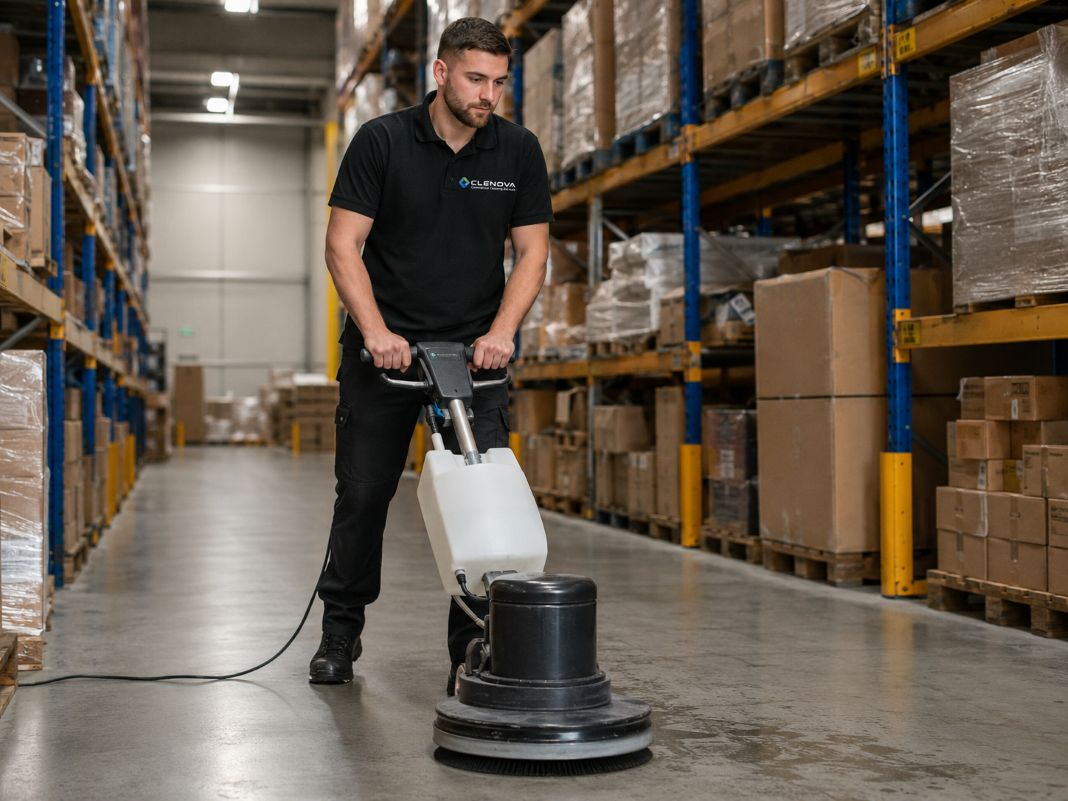
Table of Contents
Warehouse cleaning starts with zones, tasks and frequency
A proper warehouse cleaning scope begins with the way your site is used. A single line such as “keep warehouse clean” leaves too much open to interpretation, especially in mixed premises where the warehouse, office and staff areas all need different attention.
Across London and Greater London, we see warehouse contracts work best when the site is divided into clear zones. Those zones may include picking aisles, storage areas, warehouse racking, traffic routes, pedestrian routes, loading bays, external approaches, toilets, kitchens, staff rooms, office areas, mezzanine areas and waste points. Each area then needs its own task and frequency, because sweeping a warehouse floor is a different job from cleaning a staff kitchen or removing dust from high-level ledges.
Health and Safety Executive guidance says employers must provide welfare facilities and a working environment that is healthy and safe for everyone in the workplace. In cleaning terms, that means welfare areas, waste points, floors and shared routes cannot sit outside the contract unless someone else has clear responsibility for them.
Good scope writing also makes exclusions visible. If high-level cleaning, racking dust removal, specialist floor work or external yard cleaning is outside the routine service, the schedule should say so plainly. Clear wording gives both sides a shared reference before the contract starts, instead of leaving managers to argue later about what “clean warehouse” meant.
Routine, periodic and specialist tasks belong in separate lines
Strong warehouse cleaning contracts separate regular tasks from planned deep cleaning and specialist work. That distinction matters because the same area may need several types of cleaning, each with different timing, access and equipment.
Here is the practical difference we use when reviewing a warehouse cleaning specification.
| Type of work | Typical purpose | Why it should be scoped separately |
|---|---|---|
| Routine cleaning | Keeps high-use areas, welfare spaces, bins and accessible floors under control during normal operation | Frequency depends on use, waste, staff numbers and access windows |
| Periodic cleaning | Deals with standards that build over time, such as deeper floor work, ledges and planned dust removal | These tasks may need extra time, different equipment or a planned shutdown area |
| Specialist cleaning | Covers work such as high-level warehouse cleaning, racking cleaning, difficult floor treatment or project cleans | Access, supervision and safety controls need to be agreed before work starts |
| Spill response | Deals with spillages or contamination outside the normal schedule | Expectations need to be realistic, especially where production, stock or vehicle movement is involved |
Floor cleaning is a good example. A warehouse floor may need sweeping, spot cleaning, machine scrubbing or deeper floor care, but those jobs do not always happen at the same frequency. Treating “warehouse floor cleaning” as one general line creates confusion when the proposal reaches day-to-day delivery.
Safety also affects the scope. Health and Safety Executive warehousing guidance identifies slips and trips as one of the main causes of accidents in warehousing and storage, and floor contamination can include water, oil, cleaning products, dry powders, foodstuffs, stretch wrapping, label backing and plastic bags. Your cleaning schedule should say how routine contamination is handled and how prompt spill clearance fits with site rules.
High-level work needs separate treatment. Racking beams, ledges, mezzanine edges and other raised surfaces may need working at height controls or access equipment, so those tasks should never be hidden inside a general dusting line.

Cleaning frequency follows use, risk and access
Warehouse cleaning frequency is set by how the site operates. Picking volume, deliveries, shift patterns, packaging waste, floor type, stock sensitivity and welfare use all change what is needed.
Frequency is not just how often cleaners attend; it is what they can safely and usefully do while they are there. A busy loading bay with vehicle movements needs different planning from a low-traffic storage aisle. Staff welfare areas may need attention on a different pattern again, especially where food waste, toilets and changing areas are used throughout shifts.
London adds practical constraints that generic warehouse cleaning checklists rarely address. Restricted loading, multi-tenant estates, shared access roads, security gates and out-of-hours rules can all affect when cleaning takes place. In mixed office and warehouse premises, the office areas may be ready for cleaning when the warehouse is still active, so access cannot be assumed across the whole site at one time.
A workable warehouse cleaning schedule leaves room for review. If your operation changes, the cleaning rota should be adjusted with it, because yesterday’s quiet aisle can become tomorrow’s main picking route.
A warehouse cleaning scope of work must be usable after the first month
A commercial cleaning scope of work needs enough detail to manage the contract once daily routines settle in. The best document is not the longest one; the best document is the one that tells everyone what happens, where it happens, how often it happens and what happens when standards slip.
At Clenova, we scope warehouse cleaning in London around visible responsibilities and management controls, so the agreement can be checked in practice. The key items we want to see in a warehouse cleaning specification are:
- Defined zones. The schedule should name the warehouse areas, offices, welfare spaces, loading bays, external approaches and shared areas that are included.
- Tasks and frequencies. Floor sweeping, floor scrubbing, bin handling, washroom cleaning, kitchen cleaning and racking dust removal should not be bundled into one vague line.
- Clear responsibility for supplies, equipment, consumables and waste points. If your team provides certain items and the contractor provides others, the scope should say exactly where that split sits.
- Exclusions and project work. High-level work, deep cleans, floor restoration and one-off warehouse deep cleaning should be stated separately if they are outside routine service.
- Access arrangements, including keys, alarms, restricted areas, vehicle routes and the times when cleaners can work without interrupting operations.
- Inspection, sign-off and follow-up. Someone needs to check the work against the scope, record issues and agree what gets corrected.
Waste deserves particular care because assumptions cause disputes. Workplace recycling rules in England came into force on 31 March 2025, and GOV.UK says micro-firms with fewer than 10 full-time equivalent employees have until 31 March 2027. Workplaces can decide container size and collection frequency based on waste volume, so bin placement and waste streams may need to appear in the cleaning scope even where a separate waste carrier handles collection.
Food waste can matter in warehouses that do not serve food, because staff rooms and canteens still generate it. Dry recyclable waste, food waste and residual waste streams should be reflected in the site arrangement where they apply. A cleaner can keep the bin area in order, but trade waste removal and collection responsibilities must be confirmed before anyone treats them as part of the cleaning contract.
Vague wording is usually where scope creep starts. A manager asks for “just this extra area”, a cleaner absorbs it for a week, and the contract slowly becomes different from the priced schedule. Recording changes keeps the service fair and keeps the warehouse cleaning contract aligned with the real site.

Site visits turn warehouse reality into a workable contract
A site visit should test how the warehouse actually runs. Imagine a unit with storage aisles, a small office, staff toilets, a kitchen, a mezzanine and a loading bay used at set times. Measuring the floor area tells us very little until we have seen the access, movement and responsibility points.
What we assess on site
During a warehouse cleaning site visit, the first job is to divide the premises into operational zones. Storage areas, traffic routes, welfare spaces and office areas all have different standards and different access limits, so one frequency across the whole premises rarely works well.
Vehicle movement matters. If forklift routes, loading slots or delivery windows limit where cleaners can work, the schedule has to respect that. Cleaning a floor at the wrong time can create its own problem, especially if wet areas sit close to pedestrian routes or stock movement.
Stock sensitivity also shapes the method. Some areas cannot tolerate dust being moved into product zones, and some shelves or racking surfaces need planned access before they can be cleaned properly. We also look at who signs off standards on your side, because a cleaning contract needs one agreed route for feedback.
What we build into the contract
At Clenova, we scope the contract from the site realities first, then set labour, frequency, equipment, supervision and management follow-up around them. Digital time and attendance monitoring helps verify that contracted hours are delivered, and regular site inspections give the service a practical check beyond whether someone appeared on the rota.
Cover planning belongs in the same discussion. Sickness and holidays happen in every cleaning operation, so trained cover operatives or supervisors need to be part of continuity planning where the contract requires it. The point is simple: your proposal should show how the work is managed after mobilisation, not just what is promised before it starts.
Security and access details need careful handling as well. Keys, alarm information and restricted areas should be agreed with authorised people only, and cleaners need site-specific procedures before they start work. A warehouse cleaning contractor in London should be able to explain those controls plainly without turning the proposal into a technical manual.
Managed scope works better over the life of the contract
A warehouse cleaning proposal can look tidy at the start and still fail in use. The weak version lists hours, a few broad tasks and a price, then leaves managers to chase missed areas when loading bays, welfare spaces or periodic work fall through the gaps.
A managed scope works differently. It sets out the zones, frequencies, access rules, attendance checks and quality checks that keep the contract measurable. A vague task list relies on memory and goodwill once the cleaners are on site.
Price still matters, but value comes from what the contract can actually control. If two proposals look similar, the stronger one is the one that shows who attends, what they cover, how standards are checked and how gaps are corrected. A warehouse cleaning contract that can be delivered, checked and adjusted will outlast one that merely looks neat on the first page.
Questions we get asked about warehouse cleaning contracts
Who is responsible for cleaning loading bays and external areas?
Responsibility should be written into the scope. Loading bays, external approaches and shared estate spaces are often missed because they sit between warehouse operations, landlords and cleaning teams.
Can warehouse cleaning be done outside operating hours?
Out-of-hours cleaning can work where access, security, vehicle movement and shift patterns allow it. The contract should state which areas can be cleaned outside operating hours and which areas need different arrangements.
Do warehouse cleaners need special equipment or training?
Some warehouse cleaning can be handled with routine commercial cleaning equipment, but floor machine work, high-level cleaning and certain product use need trained staff and agreed controls. The required equipment should follow the site and the task, not a generic list.
Should racking dust removal be included in routine cleaning?
Racking dust removal should be shown separately unless it is genuinely part of the regular schedule. Access, stock sensitivity and working at height controls can change how that work is planned.
How do you stop scope creep in a warehouse cleaning contract?
Scope creep is reduced by recording zones, tasks, frequencies, exclusions and change requests in writing. Informal extras should be reviewed and priced properly if they become part of the regular service.
This is general information, not professional advice.