
Why does your veterinary practice need strict infection control cleaning?
Veterinary practice cleaning is different because one site combines public areas, clinical rooms, animal accommodation and staff spaces. Strict infection-control cleaning controls cross-contamination between animals, people, surfaces and equipment. In a busy London practice, the cleaning plan must match clinical protocols, room use and access times.
A London vet surgery can move from reception to consultation rooms, kennels, preparation areas and treatment spaces in quick succession. Cleaners may be working after appointments, around locked rooms, or between areas with very different risks. A single generic office-cleaning scope misses those distinctions.
We see the biggest misunderstanding in the phrase “clean and tidy”. Presentation matters, but veterinary clinic infection control needs a different level of control around high-touch surfaces, patient accommodation, animal fluids and shared spaces. The cleaning contractor supports your clinical system, so the work has to follow your practice protocol instead of replacing it.
Where the practice keeps clinical control
Your clinical team decides the infection-control protocol. The outsourced cleaning service must respect that line, especially around infected cases, clinical waste, sharps, restricted areas and any room that needs practice staff input before cleaning starts.
RCVS standards reinforce that cleaning sits inside a professional practice environment. RCVS says practices working for Practice Standards Scheme accreditation must achieve Core Standards in every relevant module. Core Standards apply whether or not the practice joins the scheme. Cleaning records, room schedules and contractor instructions need to support that baseline.
Where the cleaning contractor must fit
A veterinary cleaning contractor needs to understand the difference between reception flooring and patient accommodation, between a staff kitchen and a preparation area, between a public washroom and a consultation room. Each space needs a clear scope, agreed products, defined access and an escalation route when something is outside the cleaner’s role.
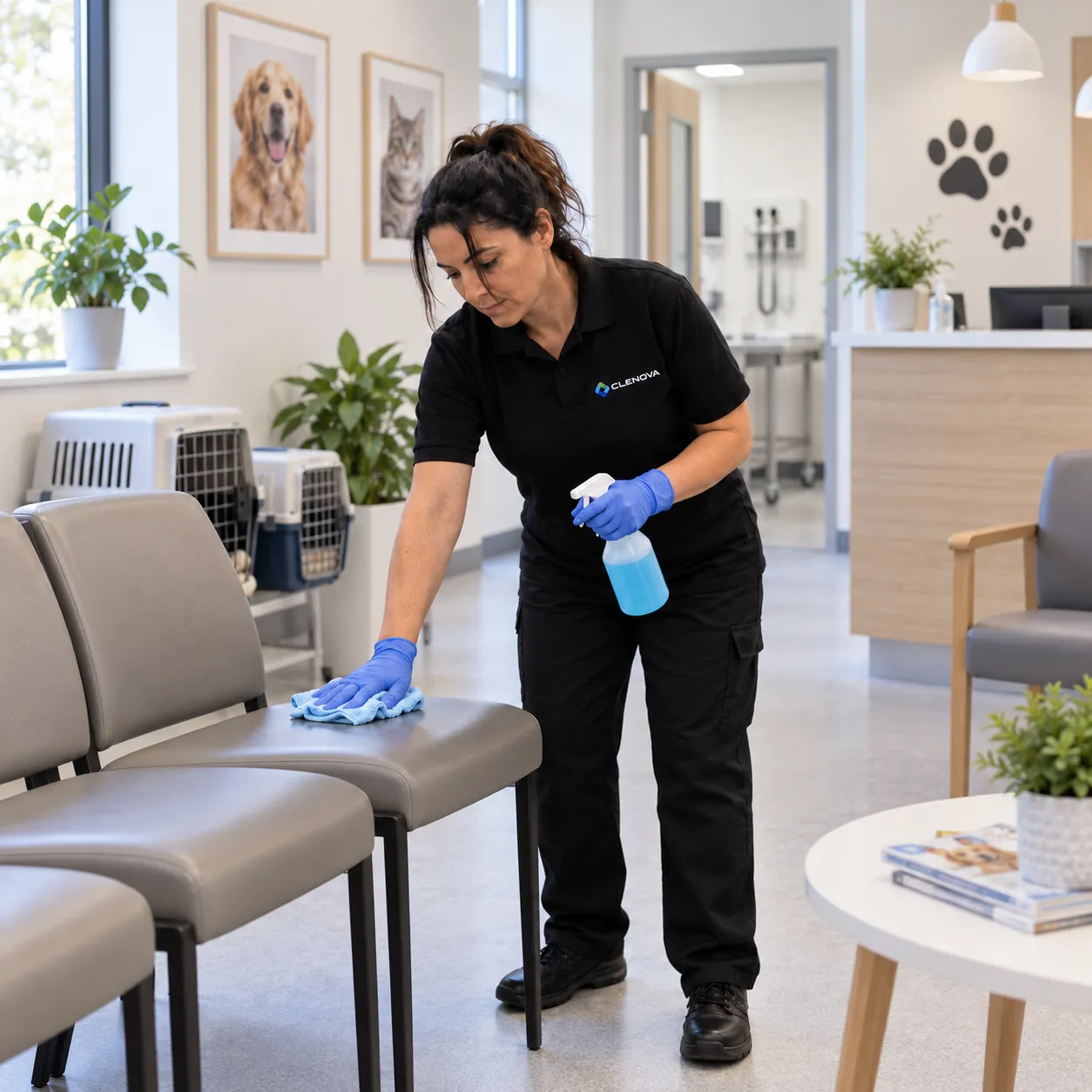
London adds pressure because practices are busy, space is tight and shared waiting areas see steady movement through the day. Your cleaning scope needs to match those divisions.
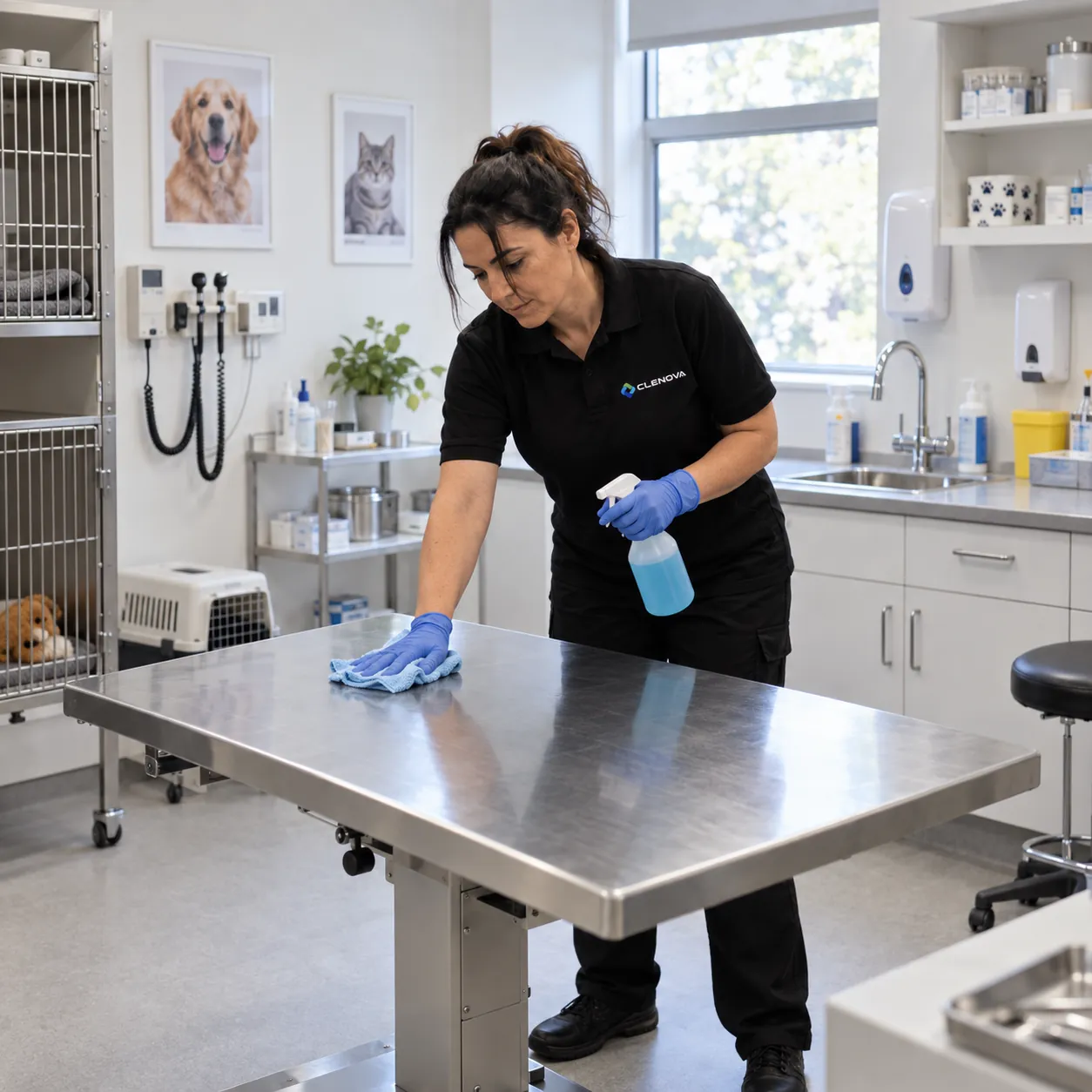
Table of Contents
Correct product use matters more than the product name
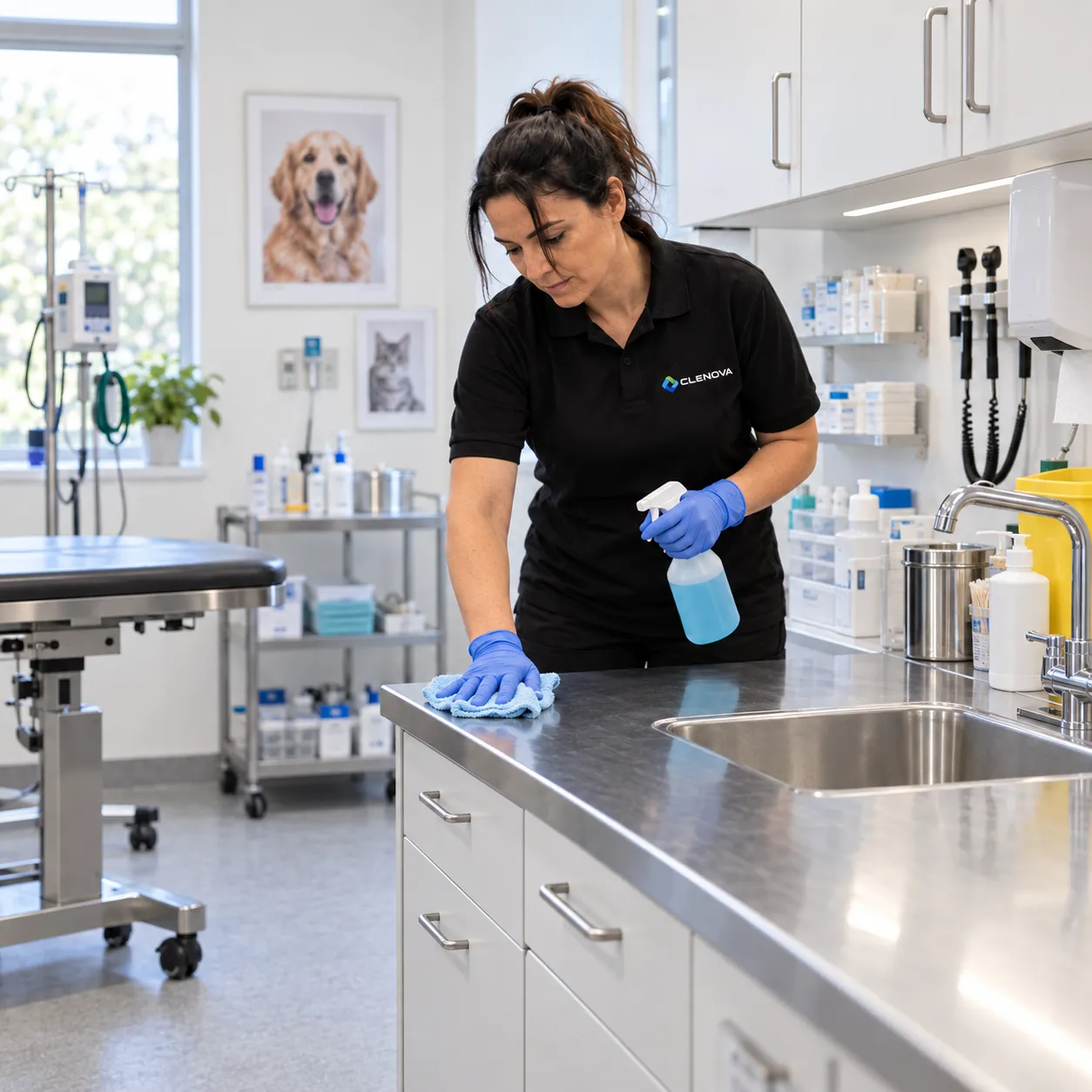
Infection-control cleaning is a controlled process with a fixed sequence. Remove visible soil, use the right product for the area, follow the required dilution, allow the stated contact time and record the work in a way the practice can check.
A phrase such as “hospital-grade” or “pet-safe” tells you very little on its own. Product discipline is practical: what surface is being cleaned, what the practice protocol says, whether the cleaner has been trained, and whether the product is being used correctly each time.
The table below separates the claims that sound specialist from the things that actually change the outcome.
| What sounds specialist | What actually matters |
|---|---|
| “We use strong disinfectant” | The product matches the practice protocol and the surface being treated. |
| “We clean clinical rooms thoroughly” | Cleaning happens before disinfection, with a defined routine for each room type. |
| “Our cleaners know vet sites” | Training covers boundaries, infected-case instructions and when to escalate. |
| “We can use Defra-approved products” | Approved products are a legal requirement only during a notifiable disease outbreak, so correct routine use matters more. |
GOV.UK is clear on the Defra point: routine vet surgery cleaning does not legally require a Defra-approved disinfectant unless there is an outbreak of a notifiable animal disease. During such an outbreak, the legal position changes and the approved product must be used. That distinction matters because a vague product claim can hide weak cleaning management.
RCVS Day One Skills for small-animal veterinary nurses include implementing an infection-control strategy according to practice protocol, preparing cleaning and disinfectant solutions, and cleaning patient accommodation, examination rooms, preparation areas and the operating theatre. Outsourced cleaners should sit beside that clinical responsibility, with instructions that stop overlap and confusion.
We want the cleaning plan to be simple enough for operatives to follow every shift and specific enough for the practice to audit. Repeatable use beats a product label every time.
Infection control protects everyone who uses the practice
Who is infection-control cleaning really protecting? It protects the whole working system around the practice, including staff, clients, visitors and animal patients, because contamination does not respect job titles or room labels.
Zoonoses are infections that can pass between animals and humans, and HSE guidance treats the micro-organisms behind them as covered by COSHH. Your cleaning contractor therefore needs training, clear instructions and review, so the cleaning supports the controls your practice already has in place.
Cleaner boundaries are a big part of this. A cleaner should know what to clean as routine, what to leave for clinical staff, and what to report straight away. Sharps, clinical waste and animal fluids need clear practice procedures, not guesswork at the end of a shift.
Hand hygiene also shows why surface cleaning and staff practice belong in the same system. HSE guidance states that hand gels should not be used as an alternative for cleaning hands. In practical terms, we read that as a reminder that shortcuts do not replace the basics, whether the issue is hands, surfaces or shared equipment.
Training and review stop standards drifting after the first few weeks of a contract. A cleaner who knows the boundary is safer than a cleaner who guesses.
Contract controls decide whether standards hold
When a cleaner is absent or a room is missed, infection-control cleaning only stays reliable if the contract has controls built in before the problem appears. Effort at the front line matters, but management decides whether the routine holds together.
At Clenova, we look at veterinary practice cleaning in London as a managed service with documented duties, attendance monitoring and follow-up. The useful question for your practice is whether the contract gives you proof that the agreed work is happening.
Use this as a practical check when reviewing a veterinary cleaning contract:
- A written room scope. The document should separate reception, consultation rooms, kennels, treatment areas, staff spaces and washrooms instead of treating the whole practice as one area.
- Attendance verification that matches the contract. Digital time and attendance monitoring gives management a way to check that contracted hours are being delivered.
- Trained cover for absence. Sickness and annual leave should not leave the practice rearranging the clean at short notice.
- Quality checks with follow-up. Regular inspections matter because standards can slip in small ways before anyone raises a complaint.
- A named escalation route. Your team should know who takes responsibility when a missed area, product issue or access problem needs fixing.
A strong infection-control cleaning contractor also adapts to site access. Some London practices have narrow windows after closing, alarm requirements, key controls and rooms that cannot be entered without permission. Those details belong in the operating plan, not in informal messages that only one person remembers.
Good supervision removes uncertainty from the contract. If a task is missed, you should not have to work out whether the cause was access, absence, unclear scope or lack of training.
Judge the contract by what you can verify
A proposal for vet surgery cleaning can look convincing if it lists enough tasks. The better test is whether you can trace responsibility through the service: who sets the scope, who trains the cleaner, who verifies attendance, who checks standards and who corrects issues.
One claim says the contractor understands veterinary practice cleaning standards. The evidence shows how the work is controlled inside your premises. That evidence may be a clear cleaning specification, site-specific procedures, inspection notes, attendance records or a plain route for raising concerns when something falls short.
Clenova approaches this as management-led cleaning because veterinary practices need more than effort in the room. We align cleaning delivery with the practice’s own protocols, keep attention on attendance and quality checks, and make sure problems have somewhere to go before they become repeated service failures.
Once you know what to look for, the decision becomes less about cleaning language and more about control you can verify. A strict infection-control cleaning service leaves you able to see the system, challenge the gaps and know exactly who owns the fix.
Questions practice managers ask us about veterinary practice cleaning
Can cleaners work outside normal practice hours?
Yes, cleaners can work outside your opening hours if access, alarms, keys and room restrictions are agreed in advance. The important point is that after-hours cleaning still follows the same practice protocol and reporting route.
Should reception areas and clinical areas use the same cleaning equipment?
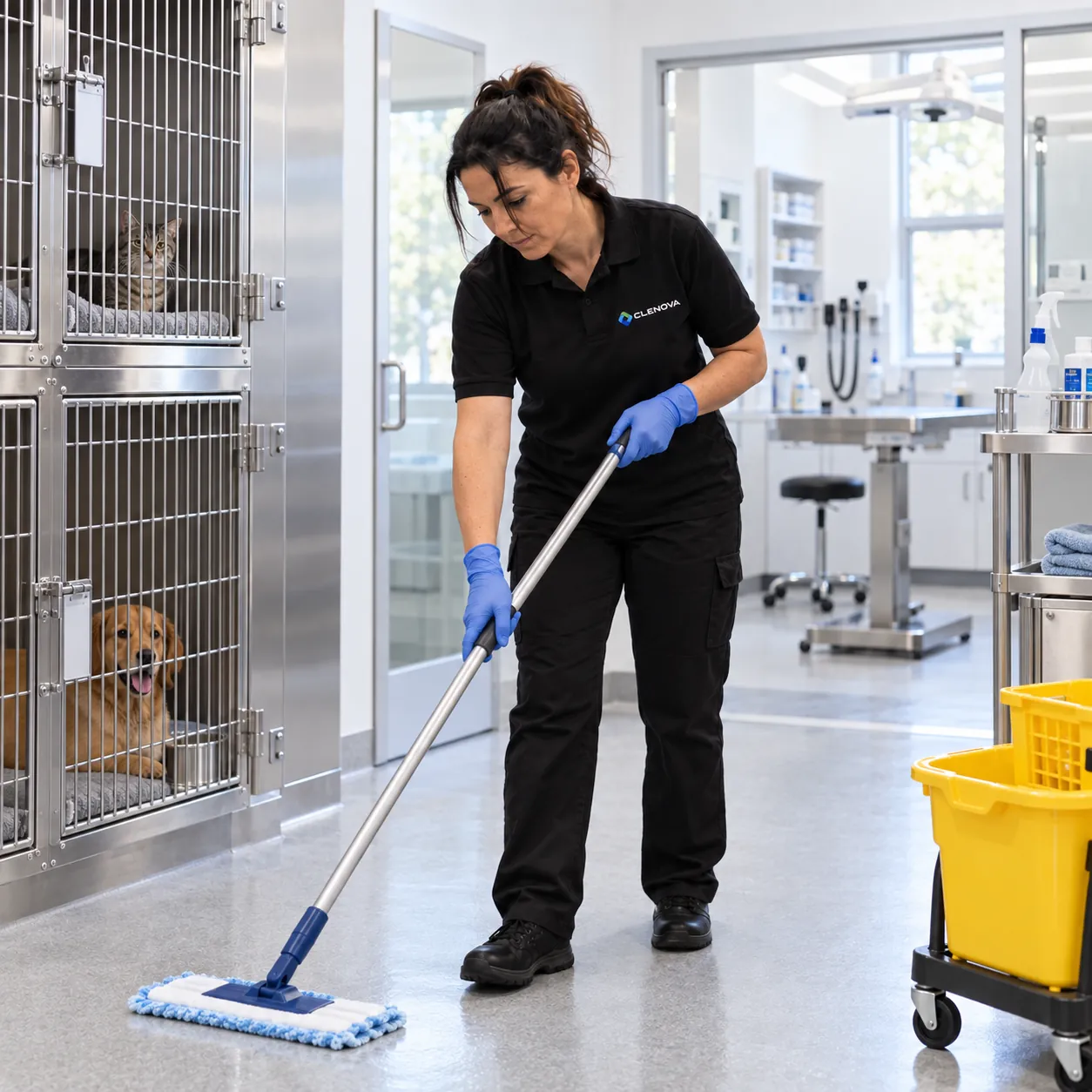
No, we would expect the cleaning plan to separate equipment use by area and risk. Colour coding and site-specific instructions help prevent equipment from moving contamination from one zone to another.
Who supplies the cleaning products for a veterinary practice?
The contract should make that clear before the service starts. Product choice needs to match your practice protocol, the surfaces being cleaned and any specific instructions from the clinical team.
What happens if a cleaner finds clinical waste or sharps in the wrong place?
The cleaner should stop, avoid handling it and escalate it through the agreed practice route. Clear boundaries protect both the cleaning team and your staff.
How do quality checks work in a veterinary cleaning contract?
Quality checks compare the agreed scope with what is happening on site. We use them to spot missed areas, training needs or access issues, then assign follow-up so the same problem does not keep returning.