
What should you expect from communal area cleaning in a London mixed use development?
We treat communal area cleaning in mixed use London developments as a managed contract: clear scope, reliable attendance, checked standards and prompt follow-up when issues appear. Entrances, lifts, corridors, stairs and bin stores matter, but the real test is whether shared spaces stay presentable for residents, tenants and visitors.

Table of Contents
Communal area cleaning is a managed standard across shared space
The easy assumption is a task list. In practice, a mixed use building needs a standard that survives different people using the same routes at different times.
Communal area cleaning covers the common parts of the building: entrances, lobbies, corridors, lifts, stairwells, landings, post areas, internal glass, shared facilities and bin stores. In a London block with commercial units below residents, those areas do more than link one door to another. They carry resident complaints, tenant presentation, visitor access, deliveries and the everyday sign of whether the building is being looked after.
Managing agents, resident management companies, right to manage companies, freeholders and property managers need a cleaning specification that they can explain and evidence. A vague instruction to keep common parts tidy leaves too much open to interpretation. A useful specification says what is included, how often we attend, how issues are reported and how standards are checked.
Cleaning removes the visible problem in front of us. Management keeps the service consistent over time. That difference matters across London and Greater London, where mixed use developments can have resident access, office visitors, retail customers and contractors moving through the same shared areas in very different patterns.
Mixed use buildings put uneven pressure on the same common parts
Take a building with residents above commercial occupiers. The entrance may be quiet for part of the day, then carry deliveries, office visitors, retail customers and residents returning through the same route. A schedule copied from a simple residential block will miss that pattern.
Mixed use communal cleaning fails when the specification ignores how the building is actually used. We look at the points where pressure builds, then make sure the scope reflects those points instead of relying on a generic rota.
The main pressures are usually easy to spot once you stop treating the building as one audience:
- Different users: residents, visitors, contractors and commercial staff leave different kinds of mess and create different complaint patterns.
- Uneven access: some areas need attention around trading hours, deliveries or out-of-hours movement.
- Waste movement can affect lifts, corridors and bin stores, especially where packaging or food waste is part of the commercial use.
- Two standards are being judged: residents look at daily living conditions, while commercial occupiers judge whether building management supports their own presentation.
Waste deserves particular care in mixed use sites. Defra’s Simpler Recycling workplace recycling rules in England changed on 31 March 2025, requiring workplaces to separate dry recyclable materials, food waste and non-recyclable waste before collection. Those rules apply to waste produced by employees, customers and visitors, so commercial occupiers can affect bin store layout, labelling and cleaning routines.
A cleaner cannot enforce tenant behaviour or lease covenants. What we can do is report recurring rubbish, blocked access, spills, misuse of bin stores and areas where the scope no longer fits the building’s use. The managing agent or responsible party then has the evidence needed to act.
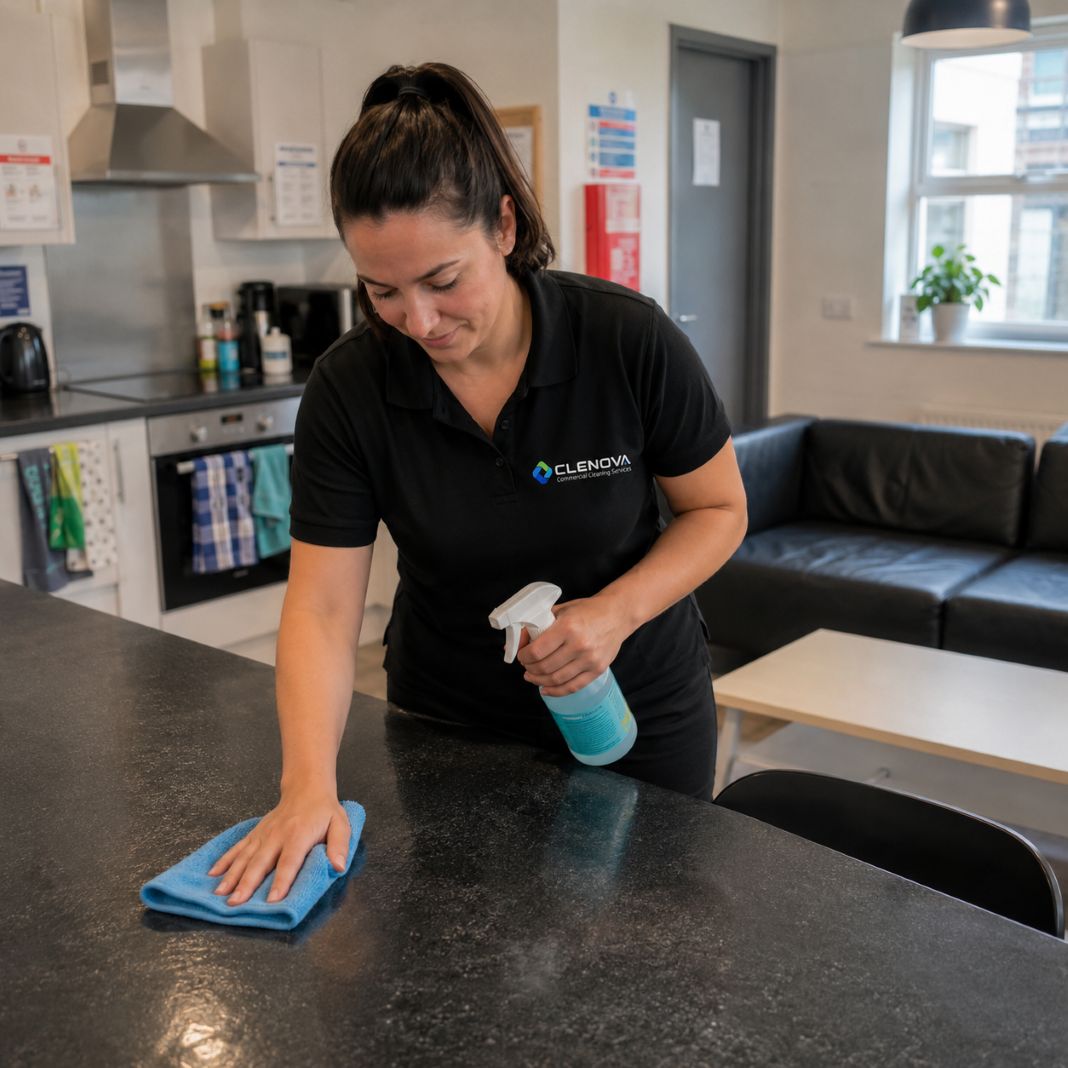
A useful cleaning schedule follows the building rather than habit
A communal area cleaning schedule should be built around use, layout and risk, not copied from another block. Frequency depends on footfall, flooring, commercial activity, waste volumes, access arrangements and resident expectations.
We start by separating routine cleaning from planned support work. That keeps the daily service clear and stops specialist tasks from being quietly assumed inside a contract that was never priced or managed for them.
Core common parts
Core common parts usually include entrances, lobbies, corridors, lifts, stairs, landings, post areas and internal glazing. Bin stores need their own wording because they carry different risks from a corridor or lobby. A good schedule says what we check, what we clean, what we report and where repeated issues go next.
Residential common parts and commercial tenant areas may also need different timing. A shared entrance to flats and offices does not behave like a private residential hallway. Cleaning shared areas in mixed-use buildings means matching the contract to the building’s daily use, not asking one cleaner to guess what matters most on each visit.
Periodic and specialist cleaning
Planned work such as carpet cleaning, floor care, high-level cleaning, window cleaning and deep cleaning sits best as a separate programme. Folding every occasional task into the routine rota makes the contract harder to measure because nobody can see what has been delivered on a normal attendance.
Control of Substances Hazardous to Health, the rules for handling cleaning products safely, also belongs in the background of a managed service. You do not need a chemistry lesson from your contractor, but you do need confidence that products, equipment and site instructions match the premises.

Attendance, quality and issues need visible checks
“How do we know the hours were delivered?” That is the question we expect from a managing agent who has dealt with standards slipping after the first few weeks. A cleaning promise carries little weight unless attendance, quality and follow-up are checked.
At Clenova, we use digital time and attendance monitoring to help verify contracted hours, then back that with regular site inspections and quality checks. The point is simple: communal cleaning contractor London decisions should be based on delivery evidence, not a line in a proposal that says “daily clean”.
Here is the difference between a weak signal and a managed contract signal.
| Weak contract signal | Managed contract signal |
|---|---|
| A rota says the building is cleaned on set days. | Attendance records help show whether contracted time was delivered. |
| Complaints are handled informally when someone chases. | Issues are logged, investigated and followed up through management. |
| Standards are judged only when residents complain. | Site inspections check whether the agreed scope is holding up. |
| Absence is dealt with once the cleaner fails to attend. | Trained cover operatives or supervisors support sickness and holiday cover. |
Quality checks matter because a mixed-use property can decline in small increments. A lift floor gets missed, bin store standards slip, internal glass gets pushed back, and the managing agent only hears about it once complaints build. We prefer a service model where those points are picked up before they become a pattern.
Direct access to management has value here. When an issue involves access, repeated waste problems or resident complaints, the cleaner alone cannot fix the whole cause. Management needs to see the pattern and respond with the right correction, which may include changing the scope, briefing the team again or reporting the matter back to you.
Long-term value comes from managed performance
Service charge scrutiny changes the way cleaning value should be judged. Residents and leaseholders are entitled to question whether they are paying for a reasonable service, and managing agents need more than a low headline price to defend a contract that affects common parts every week.
The Leasehold Advisory Service lists cleaning and lighting of communal areas as typical service charge items for most leasehold properties, and it also makes clear that service charges and the standard of work or services must be reasonable. That matters when you are choosing between a cheap block communal cleaning price and a managed service you can evidence.
Fire-route issues sit alongside that service charge pressure. London Fire Brigade says communal corridors and staircases in purpose-built flats must be kept free from clutter because clutter can block escape routes, add fuel to a fire and delay firefighting. Cleaners can report rubbish, pushchairs, bikes or other items left in shared routes, but enforcement sits with the party responsible for building management.
At Clenova, we look at labour, supervision, cover and reporting together because those are the parts that decide whether a common parts cleaning contract holds up. A price that leaves out cover or quality checks can look attractive on paper, then cost you management time through complaints, rework and uncertainty over whether the service happened.
One approach buys visible cleaning hours and hopes the building stays presentable. The better long-term approach buys a managed service that can be checked, adjusted and evidenced as the building’s use changes. In mixed use developments across London, that second model gives managing agents a cleaner building and a stronger position when residents, tenants or freeholders ask what they are paying for.

Questions we get asked about mixed use communal cleaning
Who clears rubbish left in communal corridors?
The cleaning contractor can remove agreed waste where the scope allows and report recurring rubbish left in shared routes. Enforcement of resident behaviour, lease rules or building policy sits with the managing agent, landlord, freeholder or another responsible party.
Can residents leave prams, bikes or doormats in shared corridors?
Shared corridors and staircases must be managed with fire routes in mind. The building’s own policy and fire risk arrangements matter, so cleaners should report obstructions rather than decide enforcement on site.
Do commercial tenants and residents need separate cleaning specifications?
Separate specifications are sensible where commercial use creates different timing, waste or presentation needs. A shared entrance may need one standard, while a commercial area or bin store may need a different routine.
How often should bin stores be cleaned in a mixed use development?
Bin store frequency depends on waste volume, commercial use, collection patterns and recurring issues such as spills or contamination. We usually treat bin stores as their own part of the schedule because they create different management problems from corridors and lobbies.
What information helps set the right communal cleaning scope?
Useful information includes building layout, access times, commercial uses, waste arrangements, known complaint points and any areas that regularly fall below standard. A good scope comes from how the building works day to day, not from a generic block cleaning template.
This is general information, not professional advice.