
How does cleaning support your medical practice’s CQC hygiene standards?
Cleaning supports your Care Quality Commission (CQC) hygiene standards by turning cleanliness into a managed system: clear room-by-room tasks, trained staff, attendance records, checks and action when something slips. It supports inspection evidence and infection prevention and control (IPC), but the registered provider still keeps legal responsibility for the practice.
Table of Contents
Cleaning supports CQC hygiene standards by making cleanliness visible and evidenced
Outsourced cleaning can help you show that your premises are being looked after, but it cannot move your regulatory duty onto the contractor. That point matters because many cleaning offers use loose language around medical practice cleaning and CQC hygiene standards.
Regulation 15: Premises and equipment, under the Health and Social Care Act 2008 (Regulated Activities) Regulations 2014, says premises and equipment used by a service provider must be clean, secure, suitable for purpose, properly used, properly maintained and appropriately located. CQC also says the registered provider keeps legal responsibility under Regulation 15 when duties are delegated through contracts or legal agreements to third parties, including contractors.
A cleaning company forms part of the support system. CQC does not give cleaning companies an approval badge that makes a GP surgery or clinic compliant. What matters is whether your cleaning arrangement supports your own hygiene duties through a clear schedule, trained operatives, monitoring and records that show what happened.
In practice, cleaning for CQC-regulated environments works best when it gives you control. You need to know which rooms are cleaned, which high-use surfaces are included, whether the visit took place and how shortfalls are handled. That split between duty and delivery matters when you review a cleaning contract.
Practice accountability and contractor delivery need a clear split
Your practice keeps accountability for hygiene standards; the contractor delivers the agreed cleaning and gives you evidence that the work took place. A workable contract separates oversight from day-to-day delivery, so nobody is left guessing during an audit or inspection.
| The practice keeps responsibility for | The cleaning contractor supports by |
|---|---|
| An effective infection prevention and control policy | Working to a cleaning scope that supports the premises and room use |
| An IPC lead with overall responsibility | Giving the practice manager a clear route for cleaning queries and issues |
| An IPC audit programme with evidence of issues and actions | Supplying cleaning records, quality checks and follow-up notes |
| Decisions about clinical rooms, equipment and local hygiene risks | Delivering the agreed schedule with staff trained for the site |
| Acting on shortfalls without delay | Reporting issues and completing agreed corrective action |
At Clenova, we build medical practice cleaning across London around clear scope, digital time and attendance monitoring and regular quality checks, because those are the points that stop a contract becoming guesswork. The practice still owns the hygiene standard, but the contractor must make the cleaning easy to verify.
Access arrangements and changing room use are normal operational matters for a competent provider to handle. Your contract needs enough structure to protect cleaning standards without adding another admin burden to the practice manager’s day.
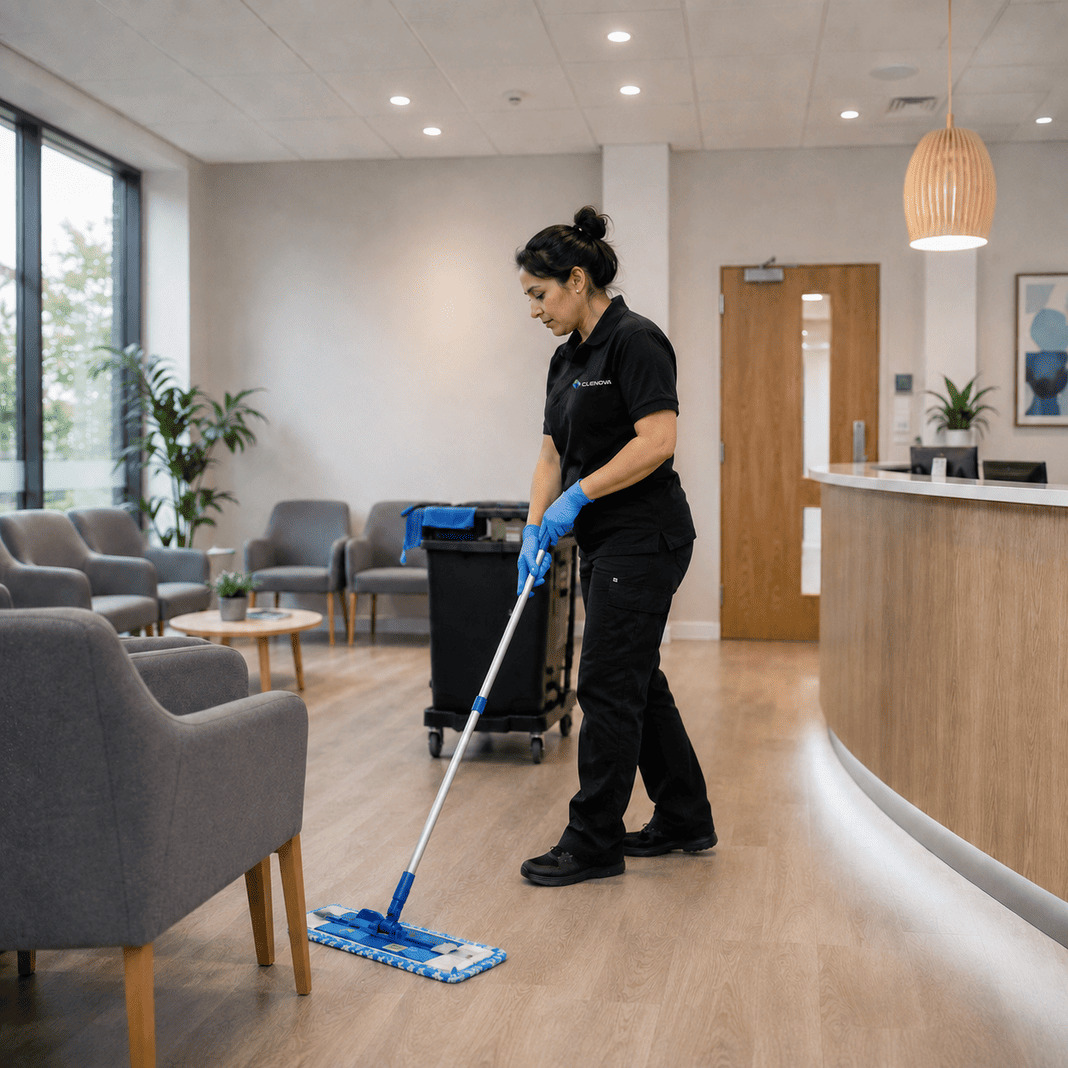
A medical practice cleaning schedule must be site-specific
“Clean clinical rooms daily” sounds useful until you ask what that means. It does not say which fixtures are included, how high-use surfaces are treated, who records the work or what happens if the room is used differently from the plan.
CQC says GP practice cleaning contractors should have a schedule of general cleaning with frequencies for specific areas, fixtures and fittings. NHS England’s National Standards of Healthcare Cleanliness 2025 also say a cleaning specification should include cleaning elements, performance parameters and cleaning frequencies.
A proper medical practice cleaning schedule should cover the points a generic office checklist misses:
- Rooms and areas: clinical rooms, consulting rooms, waiting areas, staff spaces and communal areas should be named clearly, not grouped into one vague “practice areas” line.
- High-frequency touch items: keyboards, telephones, door handles and light switches need to appear in the scope because they are handled repeatedly through the working day.
- Fixtures and fittings should be listed where they form part of the contractor’s role, so cleaners are not left to interpret the job differently from one shift to the next.
- Frequency and reason: CQC does not set one fixed cleaning frequency for every GP practice area. The schedule needs to reflect the care and treatment delivered in your setting.
- Responsibility and records should sit beside the task, so your team knows what the cleaner covers and what remains with clinical or practice staff.
- Carpets: CQC says clinical rooms should not have carpets. Consulting rooms and communal areas with carpets need a policy for cleaning, including what happens after contamination with body fluids or spillages.
A schedule like this gives the practice manager something checkable instead of a vague promise that the premises have been cleaned.
Records, audits and attendance checks show whether the system worked
Visible cleanliness tells you how a room looked at one point. Records tell you whether the system behind it was followed, and that matters when you need to show how cleaning is managed over time.
NHS England’s National Standards of Healthcare Cleanliness 2025 say healthcare establishments must be able to show how and to what standard they are being cleaned. The same standards say compliance and auditing processes should be written into contracts with cleaning service providers.
Attendance records show whether the schedule happened
A signed cleaning log has value only if it lines up with the agreed schedule and the actual visit. Attendance records reduce the risk of assuming a clean took place because nobody raised a complaint.
At Clenova, we use digital time and attendance monitoring to help verify contracted hours, alongside regular site inspections and follow-up when issues are found. That gives the practice manager a clearer view of service delivery without having to chase every shift.
Quality checks show whether the clean was acceptable
Attendance proves presence; quality checks test the result against the scope. A cleaner can attend and still miss a high-use surface, leave a room outside scope or fail to report an issue that needs correction.
Good cleaning audit evidence does not need to be theatrical. It needs to show what was checked, what fell short and what was done next. A log earns its place when someone reads it, spots the gap and fixes the cause.
Routine cover protects standards between deeper cleans
The common misconception is that a periodic deep clean is the main route to supporting CQC hygiene expectations. Deep cleaning restores, while routine management protects.
A deeper clean has its place, especially after a defined need or planned programme. It cannot make up for missed routine visits, unclear cover or slow follow-up. In a medical practice, the risk sits in the ordinary week: the cleaner who is off sick, the room that changes use, the high-use surface that falls between two vague task lists.
Busy practices across London and Greater London need cleaning arrangements that fit around clinical operations. That means access details are understood, trained cover can be arranged when the regular operative is absent and the practice manager knows who will deal with an issue without a long chain of messages.
The mistake is judging a healthcare cleaning contract by the promise of the next deep clean. A practice is better protected by the ordinary visit that happens properly, the cover that arrives when planned staff are off, and the correction that follows a missed standard before it becomes the new normal.
Questions we get asked about medical practice cleaning
Can a cleaning company be CQC approved?
No. CQC regulates the healthcare provider, not the cleaning company. A contractor can support cleaning for CQC-regulated environments, but it cannot make the practice compliant by itself.
Do GP practices need to display cleanliness star ratings?
CQC does not expect GP practices to display star ratings or logos to show standards of cleanliness. Your focus should be on a suitable cleaning schedule, monitoring, records and action when issues are found.
Does CQC set the same cleaning frequency for every room?
No. Cleaning frequency needs to reflect the use of each area and the care or treatment being delivered. Your schedule should explain the planned cleaning clearly enough for staff and cleaners to follow.
Who is responsible for cleaning clinical equipment?
Your practice should define this clearly in its cleaning responsibility framework or local procedure. Some items sit with clinical staff, while other fixtures and surfaces may sit with the cleaning contractor if they are in the agreed scope.
How should a missed clean be handled?
A missed clean should be recorded, escalated and corrected through the contract’s management process. The useful evidence is not a perfect-looking log, but a record showing that the gap was found and dealt with.
This is general information, not medical advice.