Do school cleaners need a DBS check?
A school cleaner may need a DBS check, but the correct level depends on the cleaning role, site access, chance of contact with children and whether the work counts as regulated activity. We treat “DBS checked” as too vague. You need role-specific confirmation before anyone works on site.
That distinction matters because cleaning staff are adults working in an education setting. A regular cleaner, a cover operative and a supervisor may all enter the same building, but their access pattern and duties can differ. A safe contract deals with those differences before the first shift.
At the time of writing, schools in England are working under Keeping children safe in education 2025 until 31 August 2026, with the 2026 version due from 1 September 2026. Under that guidance, contractors and contractor employees working in a school or college should have the appropriate DBS check for the role.
The mistake we see in procurement conversations is the single question, “Are your cleaners DBS checked?” A better question is, “Which DBS check applies to this role, and why?” That prevents two common failures: accepting a weak assurance, or asking for barred list information where the role is not eligible for it.
A contractor should explain the basis for the check, apply the same logic to cover staff and supervisors, and avoid old “CRB” language altogether. Safeguarding requirements belong in the cleaning contract, not in a loose side conversation after mobilisation.
Table of Contents
The right DBS level depends on the cleaning role
Two cleaners can carry out similar cleaning tasks and still need different DBS consideration because their access differs. A job title does not decide the check on its own; the real assessment turns on when the cleaner attends, where they go and whether children may be present.
Here is the practical way we would break down the issue during a school cleaning contract discussion.
| Cleaning situation | Likely check consideration | What we would want confirmed |
|---|---|---|
| Regular cleaner attending during term time with the chance of contact with children | A higher level DBS check may be needed, and children’s barred list information depends on whether the role meets the rules for regulated activity | The role assessment, access times and whether barred list information is allowed for that person |
| Cleaner who has regular opportunity for contact but is not in regulated activity | A higher level DBS check without children’s barred list information is the relevant route | Written confirmation that the check level matches the role and that barred list information has not been requested where it is not allowed |
| Cleaner working with no opportunity for regular contact with children | The school decides whether a basic DBS disclosure is appropriate | The contractor’s explanation of why regular contact is not part of the role |
| Cover cleaner replacing the usual operative | The same role-based assessment applies before the person attends | Name, identity, check status, induction position and who has approved the substitution |
| Short-term cleaning during closure periods | Access still needs to be assessed because site conditions can change during holidays | Whether children, staff or other contractors will be present, and what supervision applies |
Keeping children safe in education also makes one point that matters for London schools using mobile cleaning teams: when considering whether contact is regular, it is irrelevant whether the contractor works on one site or several sites. If a cleaner works across several school sites, the role still needs a proper assessment.
Expiry dates cause another poor shortcut. A DBS check has no official expiry date, so the relevant question is how the contractor reviews checks over time, whether the DBS Update Service is used where suitable, and whether the certificate is appropriate for the role being filled. Overseas history also needs care because a DBS check does not cover time someone lived outside the UK.
Self-employed or one-person cleaning arrangements bring a separate issue. If the individual is self-employed, the school may need to take a closer role in getting the DBS check because self-employed people cannot apply directly to DBS on their own account. A managed contractor should remove that uncertainty by taking responsibility for its own employees and giving the school clear confirmation.
DBS is not the whole check
A correct DBS certificate can still leave unmanaged gaps if the contract says nothing about identity, induction, safe working and supervision. We want schools to ask for evidence of the system around the cleaner, because that system is what keeps standards controlled after the paperwork is filed.
Before cleaning staff start, the contractor evidence should cover the following points:
- Identity and Right to Work. The person named for the role should be the person who has been checked and employed for that role.
- Appropriate DBS confirmation, with the level linked to the actual cleaning duties and site access.
- Safeguarding induction, including the school’s conduct expectations and how a cleaner raises a concern.
- Training for safe product use, storage and protective equipment, especially where cleaning chemicals are used in areas children also use.
- Supervision arrangements, including who checks attendance, who deals with issues and how cover staff are approved.
At Clenova, we use DBS checks where the site and role require them, alongside identity verification, Right to Work checks, site-specific induction and management oversight. That wording is deliberate. A blanket claim that every cleaner has the same check sounds neat, but it is not the right way to manage role eligibility.
COSHH, the rules for controlling risks from hazardous substances, belongs in this conversation as well. The Health and Safety Executive expects employers to assess and control risks from hazardous substances and give staff information, instruction and training. In a school, that means cleaning products, storage and equipment use need to be handled as part of the same managed contract.
Keeping children safe in education says safeguarding requirements for contractors should be set out in the contract between the school or college and the contractor. The contract should describe how checks, induction, training and supervision are maintained during the working relationship.
Site arrival and records must match the person
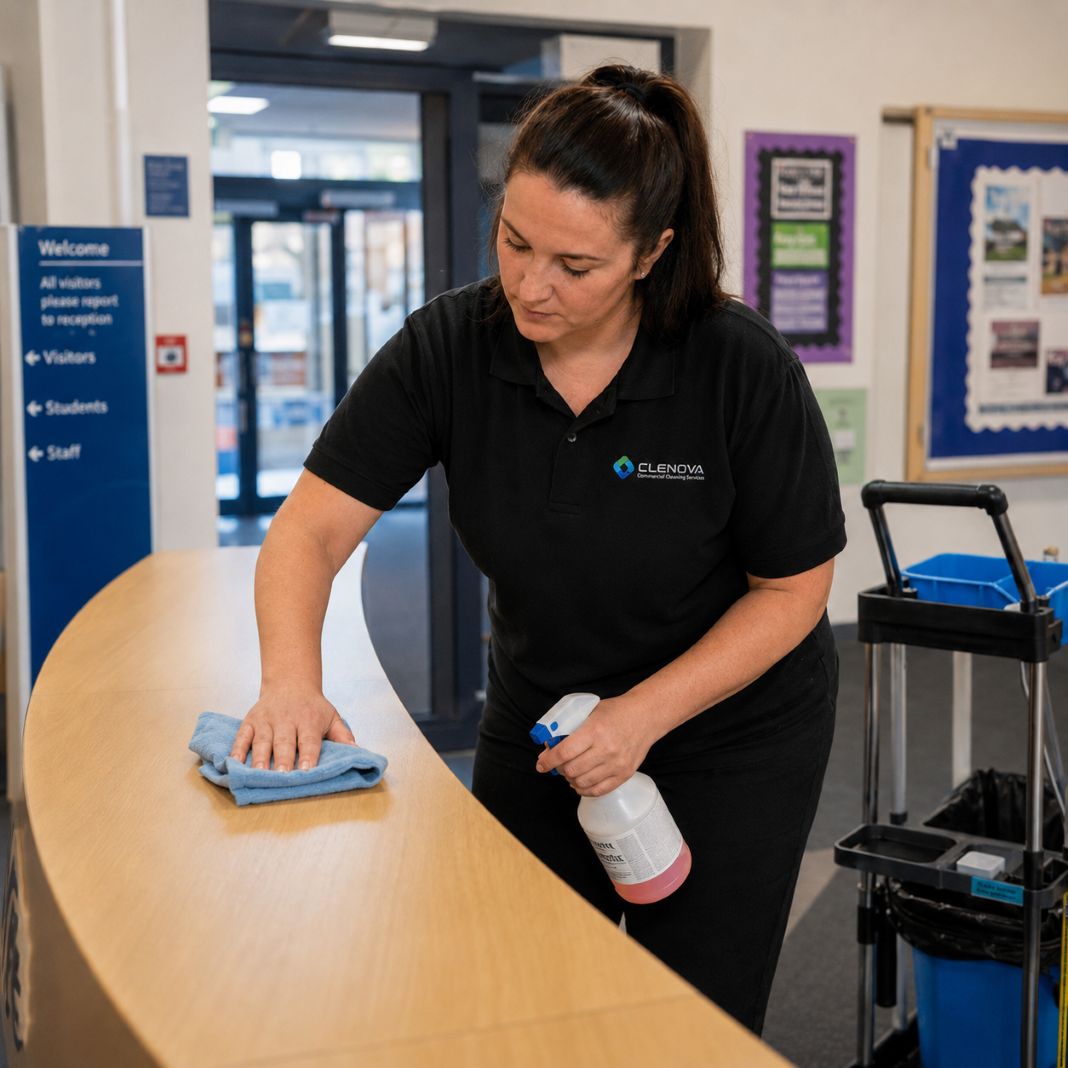
A cover cleaner arriving at reception instead of the usual operative is the moment where a good paper process either works or fails. The name, identity, expected shift and contractor confirmation all need to connect to the person standing at the door.
Identity on arrival
Schools and colleges should always check the identity of contractors on arrival. That applies during the school day and through agreed out-of-hours access routes, because early morning or after-school cleaning can create fewer casual checks by staff on site.
We look for a process that deals with ordinary substitution without improvisation. The person attending should be expected, identifiable and within the agreed access rules. Uniform and ID help, but they do not replace the school’s own arrival check.
For out-of-hours cleaning, the same principle applies through key and alarm control. Where keys or alarm details are required, access information should be restricted, coded and treated as confidential. We would rather see a simple process used every time than a complex file nobody follows at the point of entry.
Single Central Record evidence
The Single Central Record is the school’s record of pre-appointment checks. For cleaning contractors, the school needs reliable confirmation from the contractor, but that does not mean every DBS certificate should be copied and stored casually.
Keeping children safe in education is clear that DBS certificates do not need to be copied for Single Central Record purposes. If a school keeps a copy, it needs a valid reason and should not retain it for longer than the guidance allows.
Clean records matter because they help you prove the right thing. The person on site has been identified, the relevant checks have been considered and the contractor has confirmed the position. Paperwork that cannot be tied to the live attendance process gives false comfort.
Managed cover prevents check gaps
When a regular cleaner is absent, the quality of the contractor’s cover process becomes the real test of the contract. Sickness, annual leave and short-notice absence should not lead to an unknown person appearing at a London school with no clear record behind them.
Across London and Greater London, school cleaning contracts often involve early starts, after-school attendance and holiday-period work. Those patterns are manageable when the contractor controls substitution properly. The school should know who is attending, the contractor should know what checks apply, and the supervisor should have a route for correcting problems when attendance or standards slip.
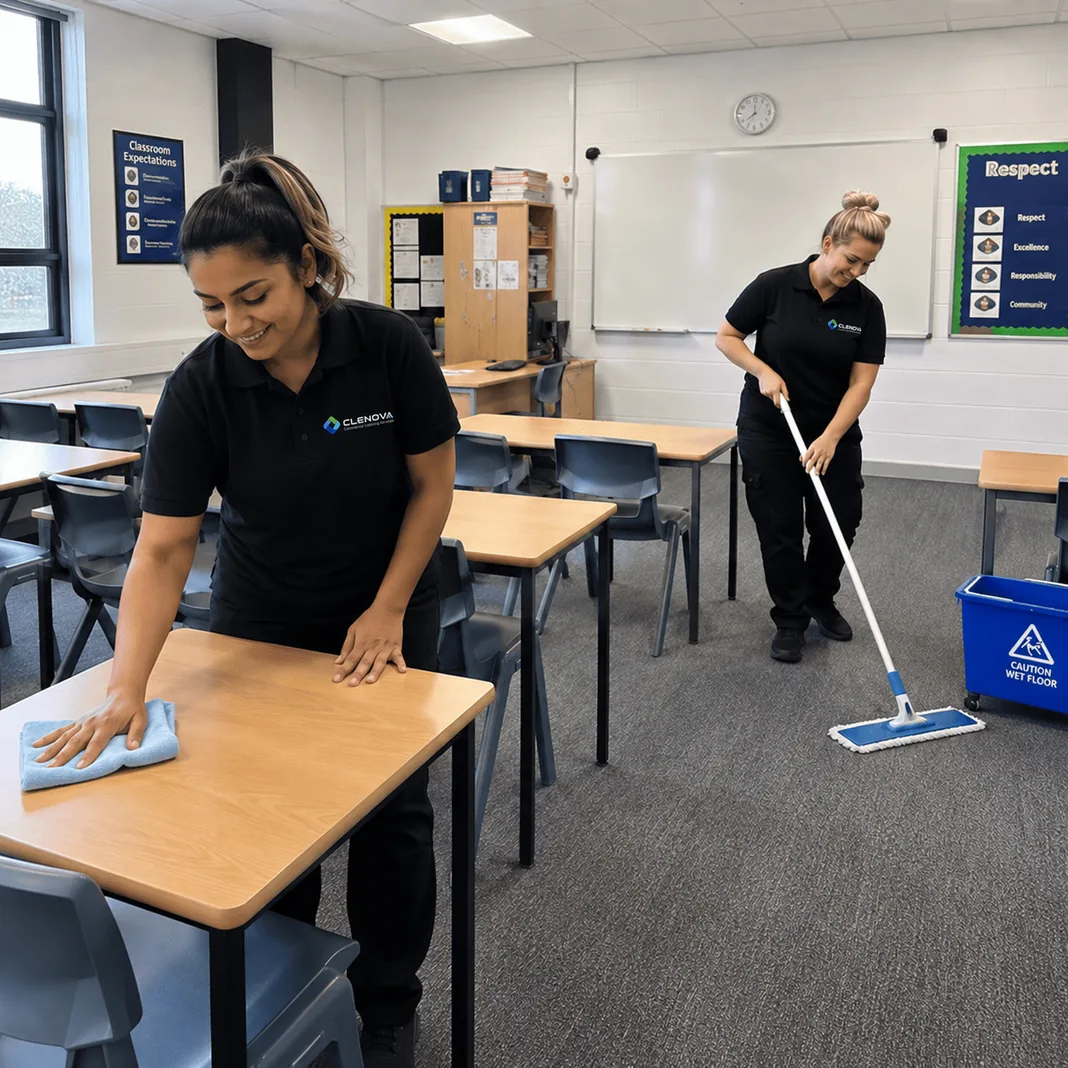
At Clenova, we support continuity by keeping the same cleaner or team on a site where possible, using trained cover operatives or supervisors when needed, and checking contracted hours through digital time and attendance monitoring. Regular site inspections and quality checks then give management a way to spot issues instead of waiting for the school to report every problem.
The priority is controlled substitution, because most check gaps start when the normal routine changes.

Questions schools ask us about cleaning staff checks
Can a cleaner work in a school while waiting for DBS confirmation?
A contractor with no checks obtained should not be allowed to work unsupervised or carry out regulated activity relating to children. The school decides the right level of supervision, and the contractor should be clear about the person’s status before they attend.
Does a DBS check have to be renewed after a fixed period?
A DBS check has no official expiry date. We would ask how the contractor reviews checks over time and whether the DBS Update Service is used where it is suitable for the role.
What happens if a cleaner has lived or worked outside the UK?
A DBS check does not cover time someone lived outside the UK. The contractor should explain how it handles overseas history as part of its recruitment and vetting process.
Should school cleaners receive safeguarding induction?
Yes, cleaning staff need to know the school’s safeguarding systems, conduct rules and escalation route. Induction turns a policy into practical instructions for the people working on site.
Should a school keep copies of DBS certificates for cleaning contractors?
DBS certificates do not need to be copied for Single Central Record purposes. If a school chooses to retain a copy, it needs a valid reason and should not keep it for longer than the guidance allows.